
On this page
CRM Showdown 2026
SaaS Lasso Editorial·
CRM Showdown 2026: Agentforce Sales vs. HubSpot Sales Hub vs. Pipedrive---Which Engine Actually Drives Your Growth?
1. Introduction: The Founder's Choice Paralysis
In 2026, the term "CRM choice paralysis" has evolved. For founders, the decision is no longer a feature-by-feature checklist; it is a high-stakes bet on an operating model. You are choosing between an All-in-One ecosystem (Outsourced Intelligence) and a **Best-of-Breed composable stack ** (Orchestrated Intelligence).The urgency of this choice is dictated by a brutal reality in unit economics. The median B2B SaaS Customer Acquisition Cost (CAC) has hit a staggering $1,200 ---a 60% increase over five years. This "efficiency squeeze" is driven by a 164% spike in Google Ads costs and an 89% surge on LinkedIn since 2019. With sales cycles now stretching to an average of 134 days, picking the wrong CRM isn't just a nuisance; it's a unit-economics catastrophe that can stall your growth before you hit Series A.
2. Agentforce and the Era of Native Agentic AI
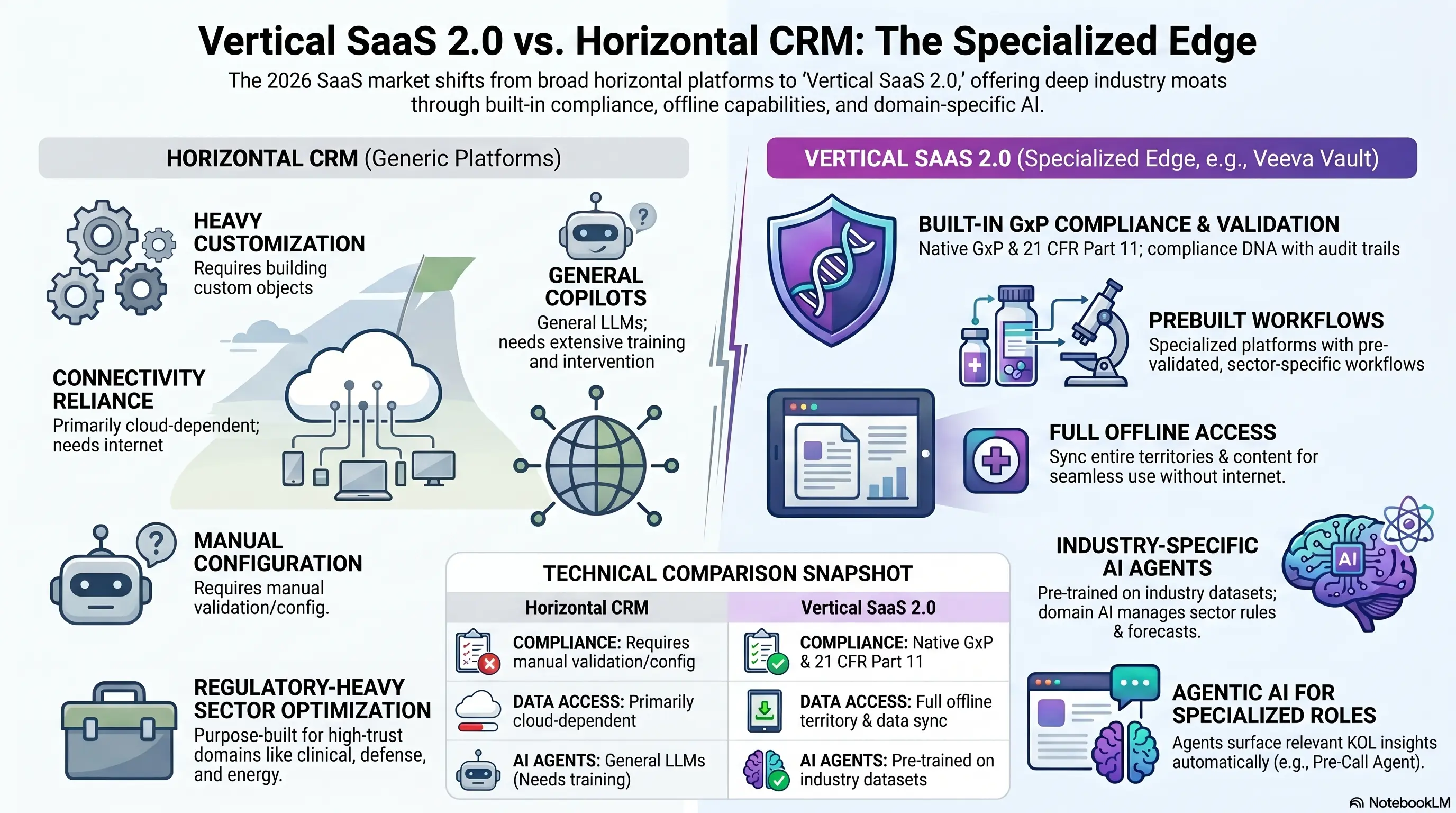
Agentforce Sales (formerly Salesforce Sales Cloud) has rebranded its core around a "Native AI Architecture." We have moved past the era of "AI-enabled" tools where a chatbot is bolted onto a legacy database. In 2026, the market has split into traditional SaaS, AI-enabled SaaS, and Native AI SaaS . Agentforce represents the latter, executing entire workflows autonomously rather than just summarizing notes.For enterprise-scale founders, this is the shift from humans using tools to agents managing routine workflows. This is particularly vital for the fastest-growing sectors of 2026: "analog-heavy" industries like healthcare, construction, and agriculture. These sectors require CRMs that don't just store data but proactively manage industry-specific logic, such as automated candidate screening or compliance-heavy scheduling."AI is projected to generate up to US$1.68 trillion in global economic value by 2031, with emerging markets such as India expected to drive a large share of this growth." --- Deloitte
3. HubSpot's All-in-One Ecosystem---The Simplicity Power Play
HubSpot Sales Hub has doubled down on the "All-in-One" philosophy. By choosing this path, founders trade modular flexibility for centralized governance and a predictable AI roadmap. The "killer app" for HubSpot in 2026 is the Embedded Services Moat .By embedding fintech and services---payroll, insurance, and payments---directly into the CRM experience, HubSpot has made the platform "stickier." For scaling mid-market firms, this is essential because Expansion ARR now contributes over 50% of new revenue for companies above $50M. An all-in-one model makes cross-selling "native," ensuring that your Sales-led and Product-Led Growth (PLG) flywheels are fueled by a single source of truth across marketing, commerce, and service.
4. Pipedrive and the Best-of-Breed/Specialized Philosophy
Pipedrive remains the standard-bearer for founders who reject a vendor-controlled future. This is the path of **Orchestrated Intelligence ** , designed for agile growth teams that want to assemble a "Best-of-Breed" stack tailored to their specific strategy.This model allows founders to leverage high-performance specialized tools rather than being locked into a single vendor's rigid roadmap. For example, a growth strategist might pair Pipedrive's specialized pipelines with a modular marketing stack like Averi---which reduces content production costs to $99/mo. In an era of $1,200 CAC, the ability to swap in lean, AI-powered tools that offer 85% lower overhead than traditional agencies is a significant competitive advantage. This path requires higher internal maturity to manage APIs and Reverse ETL, but it offers unmatched portability of data and content.
5. The 2026 Metric Shift---Pricing for Outcomes, Not Seats
The most aggressive shift in 2026 is the death of the seat-based license. If your vendor is still charging per head, they are essentially betting against your team's efficiency. Modern CRM pricing is now tied to outcomes and consumption ---successful hires, closed placements, or specific revenue milestones.This shift aligns the CRM's cost directly with your Net Revenue Retention (NRR). Since expansion revenue accounts for 40--50% of new ARR at scale, outcome-based pricing ensures your software costs only scale when your revenue does. It forces the CRM to function as a profit center rather than a static overhead cost.
6. The "Human with Agentic AI" Workforce Gap
The primary bottleneck to growth in 2026 isn't technology---it's the gap between AI capability and workforce readiness. While 80% of organizations are deploying autonomous agents, only 48% are reskilling their teams for human--AI collaboration.Founders must treat **Trust and Security ** as a core product feature. Workforce readiness includes moving toward a "defense-in-depth" security posture for agents. This means using traditional, deterministic controls to bound AI reasoning, ensuring that agents don't hallucinate or exceed their carefully limited powers."We advocate for a hybrid, defense-in-depth strategy that combines the strengths of traditional, deterministic security controls with dynamic, reasoning-based defenses." --- Google
7. The 2026 CRM Comparison Matrix
| Category | Agentforce Sales | HubSpot Sales Hub | Pipedrive |
|---|---|---|---|
| Core Philosophy | Native Agentic AI | Integrated Ecosystem | Specialized Pipeline |
| Primary Buyer | Enterprise Ops | Scaling Mid-Market | Agile Growth Teams |
| AI Model | Outsourced Intelligence | Vendor-led AI | Orchestrated AI |
| Target Vertical | Analog-Heavy/Global | Integrated Services | High-Velocity Growth |
8. Conclusion: The Question of Control
In 2026, technology follows strategy. The showdown between Agentforce, HubSpot, and Pipedrive isn't about which tool has more features; it's about which operating model fits your vision for the future of work.Whether you choose the autonomous power of Agentforce, the integrated fintech stickiness of HubSpot, or the orchestrated flexibility of Pipedrive, the goal remains the same: driving unit-economic efficiency in a high-CAC world.As you finalize your 2026 growth plan, ask yourself: Are you building a business to fit your software, or choosing software that fits the reality of your work?
If this saved you time or helped you make a better buying decision, you can support the work.
Support the WorkNo PayPal account needed.