
On this page
Faster Contract Cycles 2026
SaaS Lasso Editorial·
From Weeks to Days: The SaaS Guide to Slashing Contract Negotiation Cycles in 2026
1. Introduction: The 3.4-Week Bottleneck
In the hyper-competitive SaaS landscape of 2026, the 3.4-week average contract negotiation cycle has emerged as the primary silent killer of momentum. While technical stacks are architected to scale from 100 to 100,000+ users, the legal friction inherent in traditional "redlining" creates a time-to-value gap that destroys growth.The data is sobering: approximately 60-70% of SaaS companies fail to hit the critical 5% or less churn benchmark, largely because onboarding friction prevents users from realizing value quickly. In an era where users expect near 100% availability, legal operations must transition from reactive "firefighting" to a proactive, automated Contract Lifecycle Management (CLM) infrastructure. To hit the scalability targets required for 2026, Legal Ops must function not as a back-office gatekeeper, but as a core component of the Go-To-Market (GTM) stack.
2. Early-Stage Agility: AI-Powered Drafting from CRM Notes
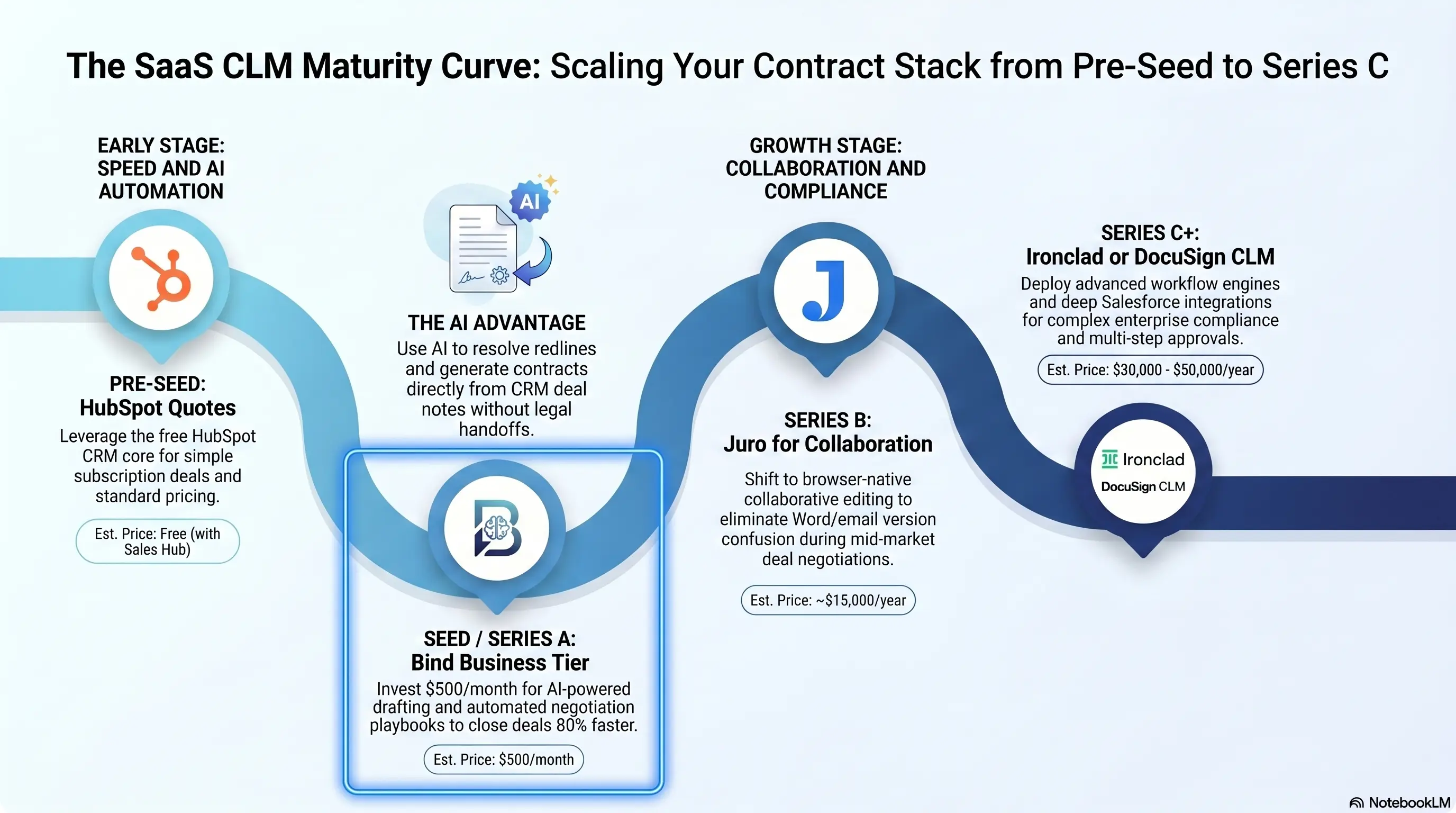
For early-stage SaaS companies, speed is the only currency that matters. At this phase, the strategic directive is to utilize Bind to eliminate the manual drafting bottleneck. Bind leverages AI to generate contracts directly from CRM notes within platforms like HubSpot or Salesforce, ensuring that the transition from a "closed-won" opportunity to an executed agreement is nearly instantaneous.This methodology mirrors the AI-driven categorization seen in advanced accounting tools like QuickBooks and Ramp. Automated categorization in these platforms reaches 95% accuracy for routine transactions by eliminating the human error inherent in manual entry. By automating the initial draft based on existing CRM data, early-stage teams avoid the "data nightmares" associated with manual entry, allowing founders to focus on implementation rather than administrative cleanup.
3. Mid-Stage Scale: Collaborative Negotiation with Browser-Native Editors
As companies move into the mid-stage, the complexity of negotiations increases, often leading to a "ping-pong" of redlines that drags cycles deep into the third week. The strategic move for mid-stage SaaS is the adoption of Juro's collaborative, browser-native editor. This approach removes the "friction of versioning" by providing a single source of truth for all parties, effectively avoiding the "QuickBooks disaster" of manual, untracked changes across multiple offline documents.This shift parallels the "recipe-based" or no-code automation found in platforms like Workato. Just as Workato empowers "citizen developers" or business users to pick up the tool and automate workflows within days---rather than the months required for enterprise-heavy systems---Juro allows business-side stakeholders to iterate on contracts without leaving their primary workspace. By centralizing the negotiation in a native browser environment, mid-stage teams ensure that every stakeholder has real-time visibility, slashing the time spent on administrative reconciliation.
4. Enterprise Precision: Deep Integrations and Strict Compliance
Enterprise-grade legal operations require a shift toward "System of Record" behavioral data and strict governance. For these teams, DocuSign CLM is the standard, providing deep Salesforce integrations and the enforcement of rigid compliance protocols necessary for global scale.The necessity for this precision parallels the reliability required by enterprise platforms like NetSuite and MuleSoft. In the enterprise tier, CLM isn't just about obtaining a signature; it is about capturing behavioral data that informs the organization's GTM and product roadmap decisions. In 2026, enterprise legal ops must mirror the resilience of high-uptime IT infrastructure where downtime is a direct threat to revenue."Downtime is not tolerated in 2026---users expect near 100% availability."By implementing enterprise-grade CLM, Legal Operations ensures that the "nervous system" of the organization remains aware and capable of rapid reaction, supporting high-volume microservices architectures with the same rigor applied to global financial reporting.
5. The ROI of Legal Ops: Beyond the Contract
Streamlining legal operations yields benefits that extend far beyond a signed document. Based on typical 2026 SaaS pain points, the hidden costs of legal friction include:
Data Integrity: Bad categorization in contract metadata mirrors bad categorization in accounting. Source data indicates it can cost $5,000+ to untangle just six months of categorization errors. Automated CLM ensures data integrity from the start, preventing expensive retroactive cleanup.
Churn Prevention: Since acquiring a new customer costs 5x more than retaining an existing one, hitting the 5% churn benchmark is a financial necessity. Streamlined legal cycles move users to value faster, eliminating the onboarding lag that accounts for the majority of early-lifecycle churn.
Resource Allocation: By automating routine negotiations, legal teams can shift from "firefighting" to "system improvement." This mirrors the AIOps shift in DevOps, where 73% of enterprises are now using intelligence to filter noise and predict incidents, allowing highly-paid talent to focus on system architecture rather than manual tasks.
6. Conclusion: The Future of Frictionless Growth
In 2026, legal operations must function as the "nervous system" of the enterprise IT landscape---providing total awareness of contractual obligations and enabling the rapid reaction speeds required for global scale. As the digital transformation market continues its trajectory toward a projected $78.3 billion impact by 2032, the speed and agility of your legal department will become your primary competitive differentiator.Is your current legal infrastructure a bottleneck slowing your GTM stack, or is it a force multiplier enabling your journey to 100,000+ users?
If this saved you time or helped you make a better buying decision, you can support the work.
Support the WorkNo PayPal account needed.