
On this page
Integration Tax In SaaS Stack
SaaS Lasso Editorial·
The $180,000 Ghost in Your Stack: Exposing the "Integration Tax" of Best-of-Breed Tools
1. Introduction: The High Cost of a "Perfect" Stack
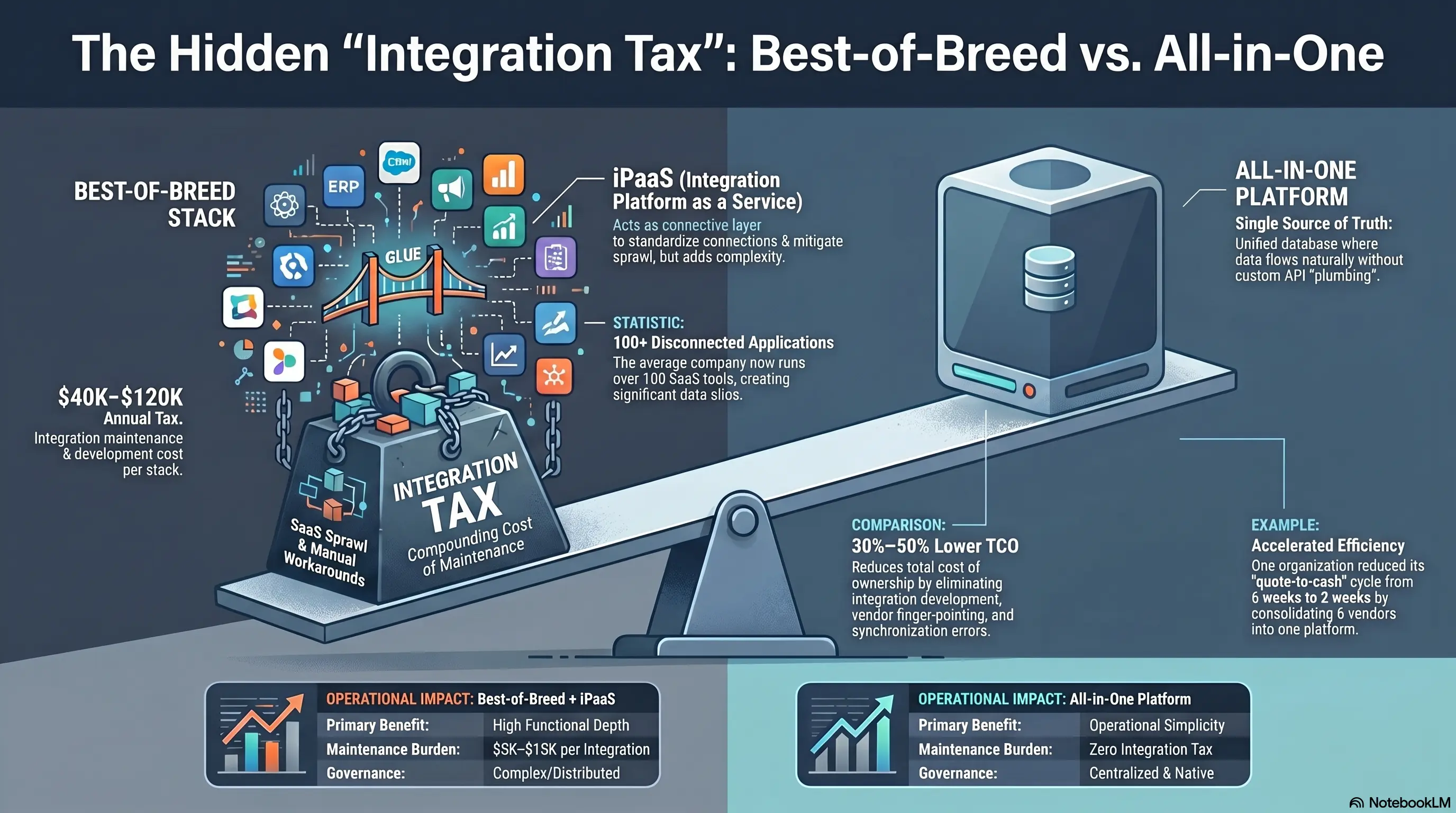
Every founder and operational lead has been there. You assemble a "dream team" of specialized SaaS tools: a best-in-class CRM, a top-tier project management platform, and a robust analytics engine. On paper, it is a masterpiece of technical engineering. In reality, operational sprawl is cannibalizing your margins.Instead of focusing on high-value strategy, your architects are bogged down in API maintenance, and your managers are manually cross-referencing data that should have synced hours ago. This is the Integration Tax ---the hidden, compounding cost of maintaining a fragmented tech stack. While individual subscriptions might look manageable on a P&L, the technical friction and synchronization failures create a massive financial drain.For a scaling company in 2026, this "tax" isn't a minor rounding error; it is a quiet siphoning of $80,000 to $180,000 from your bottom line annually. In an era where efficiency is the primary driver of valuation, your "best-of-breed" stack may actually be a $180,000 anchor.
2. The API Maintenance Black Hole
The move toward "best-of-breed" (BoB) tools is often framed as a path to agility, but it carries a crushing "governance burden." As organizations move toward a self-directed, composable future, the responsibility for how these components interact shifts from the vendor to your internal team.This tax is, at its core, a talent cost that directly impacts your ARR per Employee ---a metric that identifies the truly elite SaaS operators. According to 2026 benchmarks, the target for operational excellence is $150,000 to $250,000 per employee . When you dedicate high-salaried senior developers to fixing broken API connections or managing orchestration, you structurally reduce this efficiency. This "DIY sprawl" is the primary reason many companies remain stuck at the 25% median Rule of 40 score, while top-quartile performers (scoring 60%+) achieve higher valuations by prioritizing unified architectures.As the 'Diagram' source warns:"Governance is internal---you define architecture, integrations, and data flow. That gives you control but requires discipline... there is a risk of 'DIY sprawl' without discipline."
3. The Silent Killer: Troubleshooting Synchronization Failures
Technical friction in fragmented stacks frequently manifests as "sync failures." This occurs when your data in tools like Ramp or Brex doesn't match your QuickBooks Online ledger, or your project management platform loses track of a billable milestone.The financial impact of these failures is immediate and concrete. For example, the Bookkeeper360 data confirms that misclassified transactions and poor data categorization are "data nightmares" for founders. It is not uncommon for a business to pay $5,000+ just to untangle and fix six months of bad data categorization resulting from poor system implementation.Furthermore, when multiple systems are involved, "finger-pointing" between vendors becomes the default support experience. Your team spends expensive hours acting as a middleman between two different support desks, neither of which takes responsibility for the bridge between their products. This isn't just a headache; it is an operational leak that slows your sales cycle---which currently averages 134 days for B2B SaaS---even further.
4. Why All-in-One Architecture is the 2026 Competitive Edge
In 2026, the competitive landscape has shifted away from fragmented models toward Unified Platforms . Industry leaders are increasingly moving toward Embedded Services , integrating fintech, payroll, and onboarding directly into the core vertical experience. This allows customers to stop "stitching together" multiple vendors and start operating within a single source of truth.The most significant advantage of the unified approach is Native AI . Fragmented stacks offer "isolated AI features" (AI-Enabled) that cannot communicate across platforms. In contrast, unified architectures are built around **Native AI ** ---systems that can execute entire workflows autonomously because they have access to the full data context.According to the Deloitte concept of the "human with agentic AI" era, a fragmented stack is fundamentally incompatible with agentic AI. Agents require a unified platform to execute workflows; they cannot efficiently "click buttons" across twelve different isolated UIs.As noted in the 'HiringThing' analysis:"Deep ownership of vertical workflows is now a core factor in valuation. Vertical SaaS companies are not waiting for opportunities to come to them... they are integrating specialized capabilities into a unified platform."
5. The Operational Efficiency Math (The 180k Drain)
To justify a stack consolidation to a CFO, you must show the receipts. Here is the logical breakdown of the annual Integration Tax for a mid-market firm:
Developer Opportunity Cost ($100,000+): Based on the "governance burden" of a composable stack, most companies lose between 0.5 to 1.0 Full-Time Equivalent (FTE) of senior developer time to maintenance, API updates, and orchestration. At 2026 salary benchmarks, this is a six-figure line item of lost innovation.
Manual Data Remediation ($10,000 -****$15,000): ** Periodic "data nightmares" (e.g., Ramp/QuickBooks sync errors) require professional intervention. With cleanup costs at **$**5,000+ per event ** , two to three major sync failures a year quickly drain your cash.
Redundant Licensing Fees ($10,000 - $25,000): Companies frequently pay for overlapping features. A prime example is paying for Pendo's all-in-one analytics suite while simultaneously paying for a "best-of-breed" engagement tool like Appcues . You are double-paying for the same behavioral data.
Lost ARR per Employee ( $40,000+): When a 10-person team wastes 20% of their time on manual data entry and "sync-checking," you lose 20% of your productive capacity. If your ARR per employee target is ****$ 200,000 , that's a $40,000 loss per employee in revenue-generating potential.
6. Framework: Consolidate or Integrate?
To determine if your current stack is an asset or an anchor, evaluate your operations against these Key Decision Factors :
Talent Model Benchmark: Check your current ARR per employee . If you are below the $150,000 benchmark , you cannot afford the engineering talent required to manage a "best-of-breed" integration model.
Governance Maturity: Do you have the internal discipline to define your own architecture, or do you need the "guardrails" of a vendor-defined roadmap?
Budgeting Style: Is it easier to defend a centralized budget with large, predictable annual fees (All-in-One), or are you prepared for the cost creep of modular, smaller line items that aggregate into "Best-of-Breed" sprawl?
AI Readiness: Are you satisfied with "AI features" that suggest text, or do you need a platform capable of Native AI that can autonomously execute your industry's specific vertical workflows?
7. Conclusion: The Strategy of Simplicity
By 2026, technology must follow strategy, not the other way around. The era of the "human with agentic AI" is arriving, where AI agents will be expected to execute workflows with minimal intervention.This future requires a foundation of simplicity and data integrity. If your data is fragmented across a dozen disconnected platforms, your AI strategy will fail because your "agents" will have no single source of truth to act upon. Simplicity isn't just a preference---it is a valuation multiplier. Final Thought: In an era where AI agents are ready to execute your workflows, is your current stack a launchpad for growth, or a $180,000 anchor holding you back?
If this saved you time or helped you make a better buying decision, you can support the work.
Support the WorkNo PayPal account needed.