
On this page
SaaS Ecosystem Takeaways 2026
SaaS Lasso Editorial·
Beyond the Dashboard: 5 Impactful Takeaways for Navigating the 2026 SaaS Ecosystem
In the 2026 landscape, IT and marketing leaders are no longer just managing software; they are battling "platform debt." The friction of fragmented SaaS stacks and the administrative burden of "micro-tasks" have created a significant GTM (Go-To-Market) drag , siphoning off productivity at a time when acquiring a new customer costs five times more than retaining one.Success in this ecosystem is not determined by the sheer volume of tools in a stack, but by strategic alignment with specific organizational philosophies. The goal for modern leaders is to move beyond the dashboard and standardize operations based on industry-specific realities. This analysis distills five essential takeaways from recent market shifts to help leaders stabilize their brands and drive efficient growth.
1. Philosophy Over Features: The Analytics vs. Experience Divide
When evaluating software adoption, leaders must look past feature checklists to identify the fundamental philosophical split between "Analytics-First" and "Experience-First" platforms. **The Mental Model: Understanding vs. Action **
Analytics-First (e.g., Pendo): These platforms function as a "system of record" for behavioral data. They prioritize Understanding , giving product managers deep visibility into usage patterns to inform long-term roadmap decisions.
Experience-First (e.g., Appcues): These platforms prioritize Action . They are designed to change user behavior in real-time through personalized journeys across in-app, email, and mobile channels.Choosing the wrong philosophy for your primary objective creates significant PLG (Product-Led Growth) friction . For example, selecting an analytics-heavy tool for an engagement-focused team often results in "engineering bottlenecks," where non-technical staff must rely on developers to make guides look on-brand. Conversely, using an experience tool for deep research may lack the robust behavioral reporting required for complex roadmap planning."Relevant, well-timed experiences are what drive growth, adoption, and retention."
2. The Death of the Seat: Outcome-Based Pricing is the New Standard
The traditional seat-based subscription model is becoming obsolete. As AI and automation significantly increase the leverage of each seat , charging per user feels increasingly unnatural to modern buyers. This transition is a shift in Unit Economics : as AI executes the work, the "per seat" cost is becoming decoupled from the "per unit of value" generated.The 2026 ecosystem is moving toward outcome-based and consumption-based models:
HR Technology: Pricing is shifting to a "per hire" or "per placement" model.
Insurance: Fees are increasingly calculated based on the number of claims processed.
Manufacturing: Subscriptions are now frequently tied to units produced or shipped.By aligning costs with the actual result of the workflow rather than the login, vendors are forced to prove their value through delivered outcomes rather than mere access.
3. The Metric of Survival: Why NRR Outshines MRR
While Monthly Recurring Revenue (MRR) tracks current size, Net Revenue Retention (NRR) measures "cardiovascular fitness." In a market where new sales growth is slowing, NRR is the engine that allows a company to hit the Rule of 40 ---the industry shorthand for balancing growth and profitability---without excessive capital burn. **2026 NRR Benchmarks: **
Median NRR: 101% -- 106%
Best-in-Class: 120% -- 130%The reality check for 2026 is that expansion revenue now accounts for 40--50% of new ARR at scale. Companies with NRR above 100% grow 1.5 to 3 times faster than their peers by compounding their existing base."Existing customers now generate 40% of new ARR... if you're still obsessing over new customer acquisition while your existing customers are quietly churning or stagnating, you're building on quicksand."
4. The "Sticky" Power Play: Embedded Fintech and Services
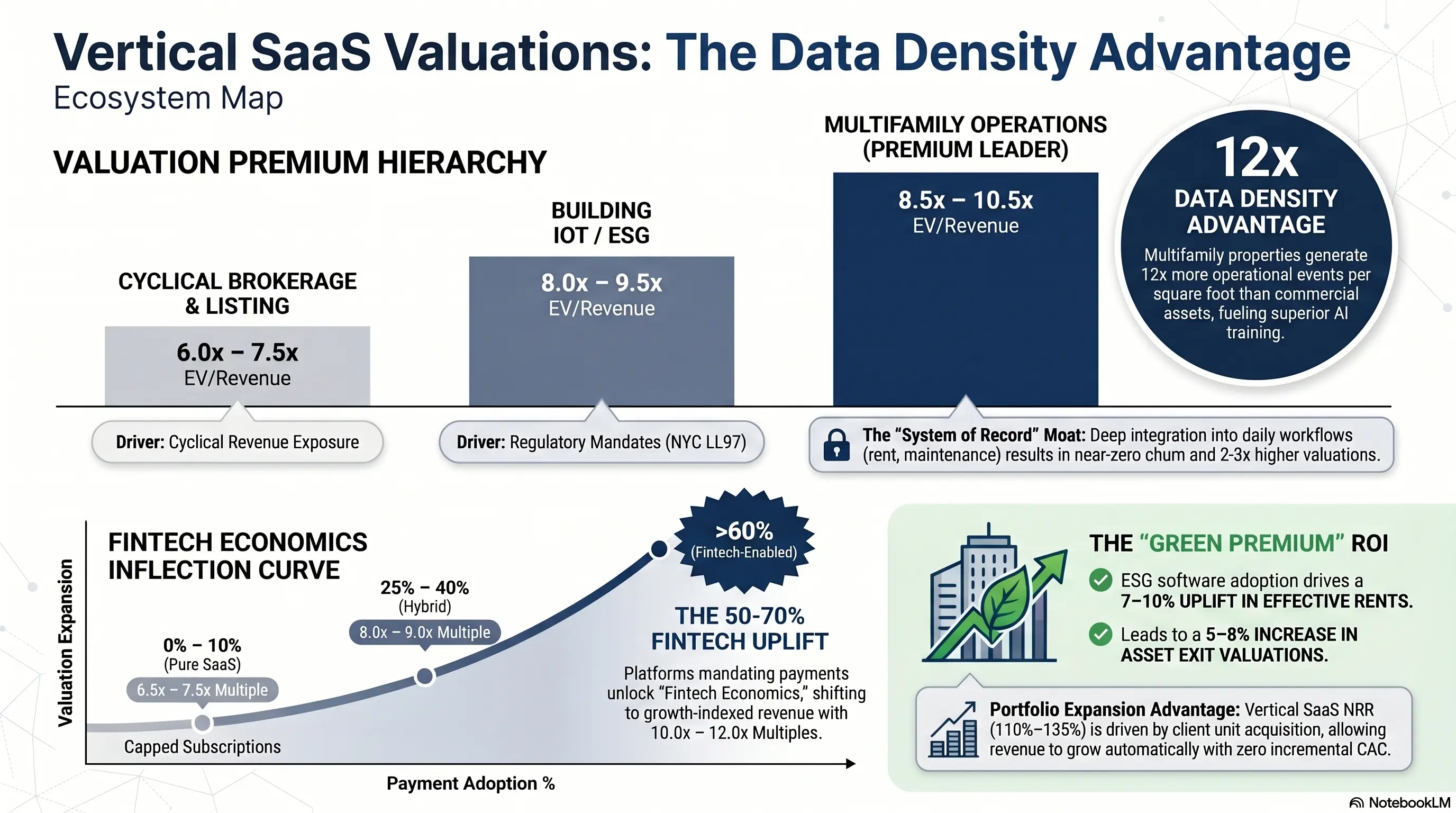
Vertical SaaS platforms have shifted from being the hunted to the "Hunters." Leading vendors are reinforcing their niche dominance by acquiring complementary tools and embedding mission-critical services directly into core workflows.By integrating functions like recruiting, payroll, and insurance, platforms drive 88% higher user engagement. Furthermore, 85% of companies implementing these services report improved customer acquisition.This is a strategic play to **increase switching costs ** . When a platform owns the entire end-to-end industry workflow---handling the payroll, the recruiting, and the insurance---the cost of "ripping and replacing" that system becomes operationally prohibitive for mid-market businesses. The software is no longer a tool; it is the industry's central control panel.
5. From "AI-Enabled" to "AI-Native" Architecture
The market is currently bifurcating into two tiers: traditional products with isolated "bolted-on" AI features and "AI-Native" platforms built from the ground up.
AI-Enabled: These products offer "assistants" that require human prompts to execute content generation or basic chat.
AI-Native: These platforms utilize real-time data pipelines and microservices to execute prescriptive workflows autonomously.We see this in specialized sectors like maritime logistics , where platforms execute autonomous regulatory checks, or eldercare management , where agents connect staffing, scheduling, and compliance without human intervention. In HRIS, the shift moves from simple "candidate sourcing" to "prescriptive risk monitoring" across the employee lifecycle. In 2026, the divider between leaders and laggards is the transition from AI as a feature to AI as a native agent capable of executing entire business processes.
Conclusion: The Question of Governance vs. Flexibility
The 2026 SaaS landscape forces a choice between two distinct digital futures:
The Vendor-Controlled Future (All-in-One): This path offers predictability and centralized compliance, but it requires surrendering flexibility. You are locked into the vendor's specific, and often rigid, AI roadmap.
The Self-Directed Future (Best-of-Breed/Composable): This path offers portability and "AI optionality." It allows organizations to integrate best-in-class AI tools as they emerge, rather than waiting for a legacy vendor to "bolt them on."As you evaluate your stack for the coming year, consider this: In 2026, is your software stack shaping your brand's future, or are you letting a vendor's roadmap dictate it?
If this saved you time or helped you make a better buying decision, you can support the work.
Support the WorkNo PayPal account needed.