
On this page
SaaS Sprawl Paradox 2026
SaaS Lasso Editorial·
The SaaS Sprawl Paradox: Why More Tools Mean Less Control in 2026 (and How to Fix It)
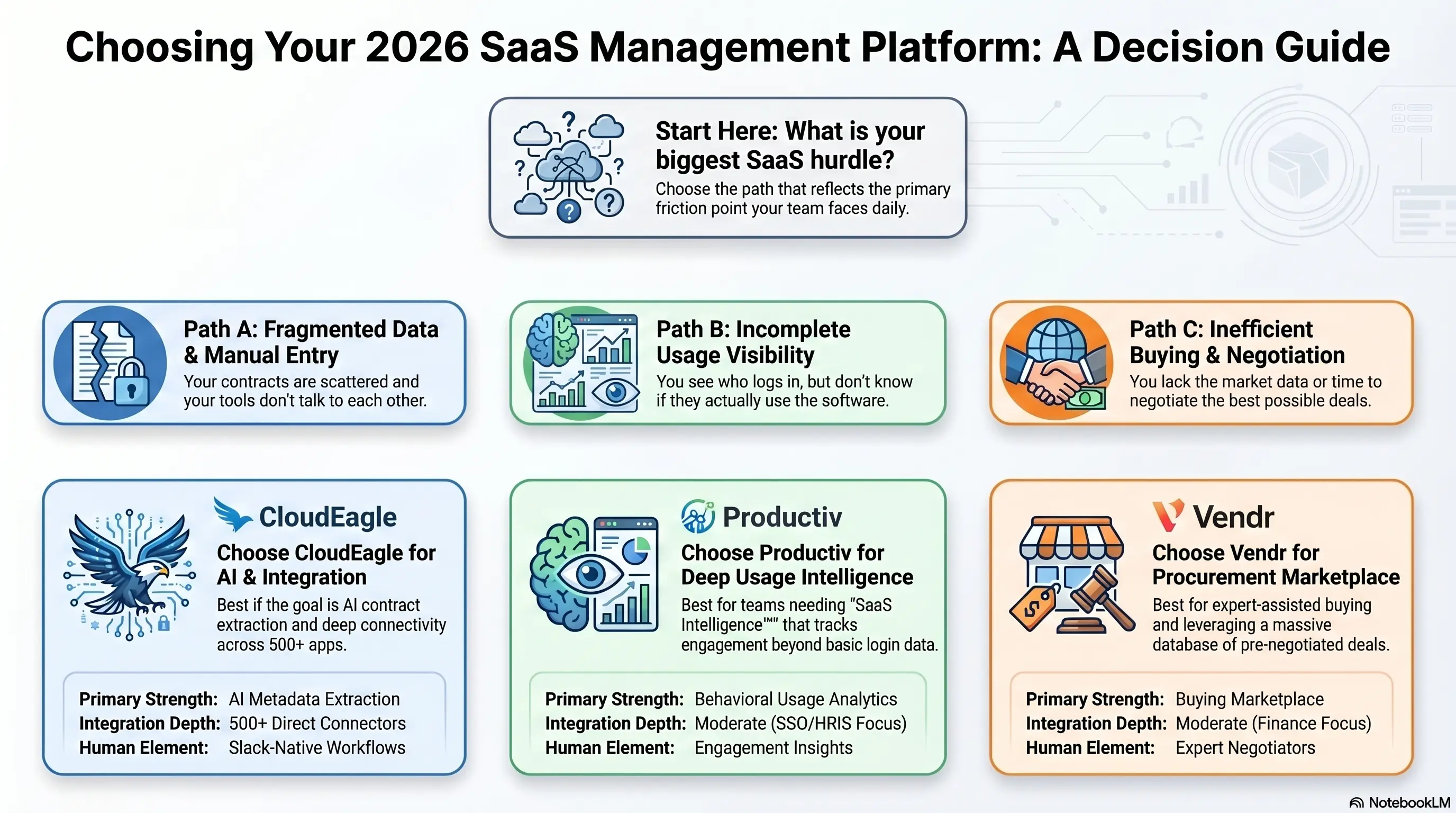
As we move through 2026, the modern enterprise architecture has reached a tipping point. What began as a transition to the cloud has evolved into a complex web of "dozens or hundreds of cloud applications" layered around central ERP hubs like NetSuite. While this modular approach promises agility, it has created a sprawl paradox: the more tools a company adopts to drive efficiency, the more visibility and control they tend to lose.In this environment, downtime, data silos, and accounting errors carry higher stakes than ever before. For an organization scaling toward 100,000+ users, a single minute of outage or a localized data error translates into significant revenue loss and a degradation of user trust. To navigate this, senior leaders are implementing the "SMP Enclosure"---a strategic boundary of SaaS Management Platforms and integrated workflows designed to keep these tools from becoming a fragmented data nightmare.
1. Implementation is the Real "Cost Center," Not the License
The uncomfortable truth in 2026 is that software value depends entirely on its foundation. Analysis of common platforms like QuickBooks Online and Xero reveals a startling trend: nearly 90% of software-related financial disasters trace back to "solo-DIY" implementations rather than technical failure. For an executive, this isn't just an operational headache; it is a significant risk to technical debt and downstream audit failures.Many business owners attempt to learn complex accounting systems in isolation, leading to misclassified transactions that remain hidden for months. In the context of a capital raise or an exit, these errors act as a "valuation hit," signaling a lack of institutional control."We've seen businesses pay $5,000+ to fix six months of bad categorization that could have been prevented with proper setup."Forward-thinking organizations now view the $350 to $10,000 per month spent on certified partners (such as Bookkeeper360) not as a line-item expense, but as a critical "data quality investment." In 2026, the strategic priority has shifted from simply "having the software" to ensuring the architectural setup is robust enough to pass due diligence.
2. AI Spend Intelligence is the New "Shadow IT" Cop
The traditional expense report is effectively obsolete. In 2026, the standard for spend visibility is defined by platforms like Ramp and Brex , which act as an intelligence layer sitting above the transaction. However, the choice between them is a matter of strategic fit rather than feature parity. Ramp is the primary choice for margin-conscious organizations, leveraging Vendor Intelligence to analyze spending patterns and find an average of 5% in savings. Its 95% AI categorization and real-time accounting sync transform the corporate card into a real-time audit tool.Conversely, Brex remains the gold standard for venture-backed startups. By utilizing cash-balance underwriting instead of credit history, Brex removes the requirement for a personal guarantee---a vital strategic detail for founders protecting personal liability while scaling rapidly. Both platforms eliminate "Shadow IT" by enforcing approvals before spend occurs, ensuring that the finance team is never caught off-guard by a surprise SaaS renewal.
3. The "Observability" Shift: Connecting Tech Health to P&L
In 2026, the complexity of microservices means that "monitoring" (knowing if something is down) is insufficient. Senior strategists are moving toward an "Observability mindset" ---knowing why a system is failing across a chain of hundreds of services.To manage the resulting "alert fatigue," 73% of enterprises have implemented AIOps . These systems use machine learning to predict incidents before they escalate into total outages. For a CFO, the value here is the reduction of Mean Time to Recovery (MTTR) . By using Distributed Tracing (Jaeger/OpenTelemetry) , engineers can pinpoint a bottleneck in seconds, directly protecting the revenue streams mentioned in our introduction.Crucially, Data Observability is the precursor to a trusted reporting environment. If the DevOps team cannot verify data lineage through OpenTelemetry, the metrics delivered to the board are fundamentally unreliable.
4. The Semantic Layer: Accuracy Over AI Hype
One of the most surprising truths of 2026 is that the **semantic layer determines accuracy, not the AI. ** While natural language queries (NLQ) are ubiquitous, they "hallucinate" when queried against raw, ungoverned data.To solve this, successful teams invest in semantic layer design before deploying AI capabilities. For example, Tableau Pulse uses "green icons" to signify certified metrics ---validated business logic that ensures everyone is looking at the same version of the truth.The standard of intelligence has also shifted. In the Google Cloud ecosystem, Looker's Gemini integration allows users to generate Python code and LookML parameters via a conversational interface. This enables advanced statistical analysis and cohort modeling that was previously the sole domain of data scientists, provided the underlying semantic layer is properly governed."Successful teams invest in semantic layer design before deploying natural language capabilities to prevent inconsistent results from undermining business value."
5. iPaaS as the Sprawl "Glue"
Because a system like NetSuite never exists in isolation, **Integration Platform as a Service (iPaaS) ** has become the essential glue of the SaaS stack. The choice of iPaaS depends on the complexity of your enterprise landscape:
Celigo: The default choice for NetSuite-centric teams. Founded by former NetSuite developers, it offers deep expertise and pre-built "Integration Apps" for Shopify and Salesforce that save weeks of custom development.
Workato: The leader for "citizen-developer" automation. Its no-code recipe approach allows business users to build multi-step workflows, such as triggering a Slack alert and an Asana task the moment a NetSuite sales order ships.
MuleSoft: The "Enterprise Service Bus" (ESB) choice for Salesforce-centric, complex landscapes. It is designed for high-governance environments where API-led connectivity and developer-driven customization are paramount.
2026 SaaS Management & Finance Comparison
| Platform | Discovery Coverage | Spend Management | Cost Optimization | Ideal Company Size |
|---|---|---|---|---|
| Ramp | High (Deep API) | Real-time controls; 95% AI Categorization | Vendor price intelligence; 5% avg. savings | 25+ Employees |
| Brex | High (SaaS-Native) | No personal guarantee; Underwriting on cash | Startup-tailored rewards; Budget enforcement | Venture-backed startups |
| Bill.com | Moderate (AP/AR) | Workflow extraction; AI invoice capture | Automated capture; Approval routing | Mid-market (50+ bills/mo) |
| Expensify | Moderate (Receipts) | SmartScan; Traditional reporting | Cash-back economics on cards | SMB to Enterprise |
| Stripe | High (Revenue) | Global tax/Revenue recognition | Fraud prevention; Subscription billing | Internet-scale SaaS |
Best for AI Feature/Contract Extraction: Ramp stands out for its "Vendor price intelligence" and superior 95% AI transaction categorization.
Best for Massive Enterprise Benchmarking: Tableau Pulse is the enterprise standard ( 75/mo) for "Cross-Metric Analysis," while Baremetrics remains the affordable ($9/mo) benchmarking choice for startups.
Conclusion: The Future-Ready Ecosystem
In the 2026 landscape, automation and modularity are non-negotiable requirements for any organization aiming to scale. The goal of a modern tech stack is not to simply add more tools, but to create a unified ecosystem where every application communicates through a governed, observable framework.As you evaluate your operations for the coming year, ask yourself: Is your current stack a collection of silos, or a unified ecosystem designed to scale with your 2026 goals?
If this saved you time or helped you make a better buying decision, you can support the work.
Support the WorkNo PayPal account needed.