
On this page
The 2026 SaaS Health Scorecard
SaaS Lasso Editorial·
The 2026 SaaS Health Scorecard: The Investor Mandate for Efficient Growth
1. The Era of Efficient Growth: A 2026 Reality Check
The "growth at all costs" era has been permanently retired. As we move through 2026, the industry has undergone a hard reset toward financial discipline and operational rigor. The loose capital of the early 2020s has been replaced by an uncompromising demand for unit economic viability.The market has reached a point of absolute alignment: generic software is being commoditized, while platforms that deeply understand specific industry workflows are capturing the lion's share of value. In 2026, efficient growth is no longer a "nice-to-have" strategy; it is the only path to a premium valuation. If your software does not possess deep vertical intelligence, you are essentially competing on price in a race to the bottom.
2. The 2026 "Health Check" Dashboard
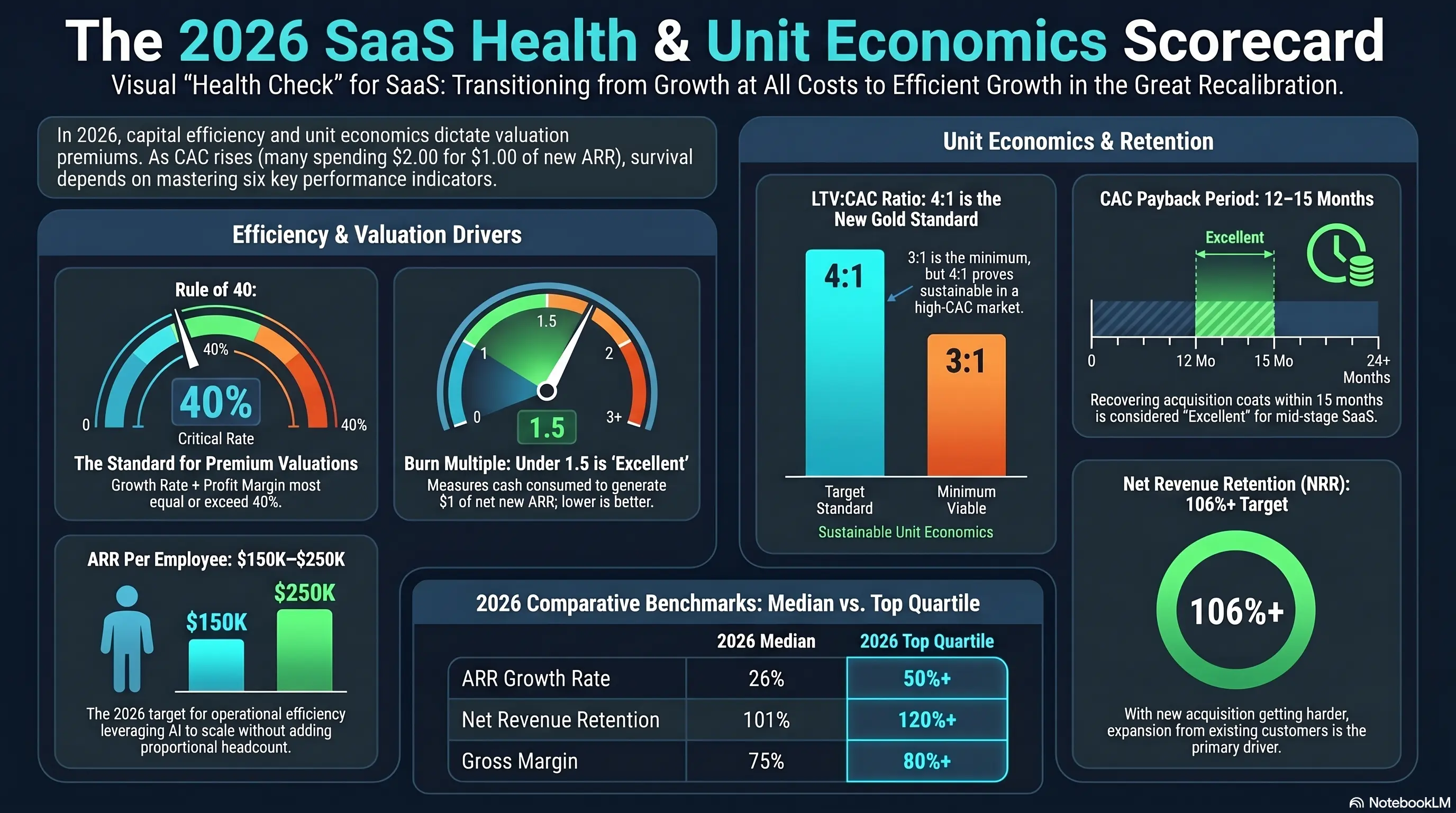
Executives must benchmark their performance against these April 2026 standards to remain competitive in the eyes of the capital markets.
| Metric | Status: Healthy 🟢 | Status: Exceptional 💎 |
|---|---|---|
| The Rule of 40 Gauge | >=40% (Growth + Profit) | >60% (Commands 2-3x Valuations) |
| The LTV:CAC Dial | 4:1 (New Insolvent Threshold) | 5:1+ (Strategic Alpha) |
| The Burn Multiple Meter | <2.0 (Sustainable Growth) | <1.5 (Excellent Efficiency) |
| NRR Pulse | 106% (Median Baseline) | 120% -- 130% (SaaS Nirvana) |
Note: A Burn Multiple $>3.0$ is now classified as a critical "Capital Efficiency Problem" for any company past the product-market fit stage.
3. Takeaway #1: The Rule of 40 is the New Valuation King
In 2026, the Rule of 40 Growth Rate + Profit Margin is the definitive shorthand for investor confidence. It provides the most honest view of whether a business model is actually functional or merely surviving on a dying war chest.Market analysis reveals a stark divide: only **11-30% of SaaS companies ** currently meet this 40% threshold. Those that clear the 60% mark are not just leading---they are dominating, commanding valuations 2-3x higher than their peers."This single metric is increasingly the investor shorthand for 'does this business work?' In 2026, it is the line in the sand that separates winners from survivors." --- Market Sentiment Analysis 2026
4. Takeaway #2: LTV:CAC 4:1 -- Why Efficiency is Non-Negotiable
The old 3:1 LTV:CAC rule is mathematically insolvent in 2026. This shift is driven by brutal customer acquisition inflation: since 2019, **Google Ads costs have surged 164% and LinkedIn Ads have risen 89% ** . With the median B2B CAC now hitting $1,200, a 4:1 ratio is the absolute minimum requirement to offset the rising cost of capital.However, a CGO must also watch for "The Under-Investment Trap." A ratio that exceeds 7:1 is rarely a sign of genius; it is usually a signal that a company is under-investing in its own growth, effectively handing market share to more aggressive, well-funded competitors.
5. Takeaway #3: The Burn Multiple -- Measuring What You Build vs. What You Burn
The Burn Multiple ( Cash Burn ** Net New ARR ) is the single best indicator of efficiency during growth phases. It exposes the raw cost of revenue: how much capital is being set on fire to generate one dollar of new recurring revenue?For mid-stage companies ( 50M ARR), the target is a 1.4 multiple .
Excellent:
Good:
Capital Efficiency Problem: $>3.0$In 2026, if you are spending $3.00 to earn $1.00 of ARR, your business model is broken, and you will find future funding rounds increasingly inaccessible.
6. Takeaway #4: NRR Compression and the Expansion Revenue Pivot
Net Revenue Retention (NRR) remains the "SaaS Nirvana," but the environment has become more challenging. We have seen median NRR compress to 101% , making expansion revenue---which now accounts for 40-50% of new ARR at scale---the primary engine for survival.To reach "Nirvana" (120-130%), executives must move beyond seat-based models. The leaders in 2026 are winning through **usage-based pricing models ** that allow them to grow alongside their customers' success.
April 2026 NRR Benchmarks
| Cohort | NRR Percentage |
|---|---|
| Median (All SaaS) | 101% |
| Best-in-Class | 120% -- 130% |
7. Takeaway #5: ARR Per Employee -- The Automation Alpha
Operational efficiency in 2026 is measured by the "Automation Alpha." The target benchmark is $150K--$**250K ** per employee.The decisive factor in hitting these numbers is the architectural shift from "AI-enabled" to "Native AI." While AI-enabled tools simply layer features over legacy processes, Native AI architectures automate entire workflows autonomously . This allows winners to scale revenue exponentially without a proportional increase in headcount, fundamentally decoupling growth from hiring.
8. Takeaway #6: Vertical SaaS -- From Niche to Defining Force
Vertical SaaS is no longer a niche play; it is the dominant market force. The global vertical SaaS market is projected to exceed **$369 billion by 2033 ** . This growth is being driven by the rapid digital transformation of "analog-heavy" industries---specifically Healthcare, Agriculture, and Construction ---which are finally adopting industry-specific cloud tools.We have entered the era of "Vertical SaaS as the Hunter." Specialized vendors are no longer acquisition targets for horizontal giants; they are the acquirers. They are aggressively buying complementary tools to own the entire mission-critical workflow of their category, thereby increasing switching costs and terminal value.
9. Takeaway #7: Embedded Services as the "Sticky Power Play"
Embedding fintech, insurance, and payroll (Embedded Finance) has become a baseline requirement for retention. Data shows that **88% of companies ** implementing embedded services report increased engagement.However, the "next frontier" for 2026 is **"Embedded HR." ** By integrating recruiting, onboarding, and payroll connectivity directly into the core platform experience, SaaS vendors are becoming the indispensable operating systems for their customers. The more mission-critical processes you embed, the higher your switching costs and the lower your churn.
10. Conclusion: The Survival of the Disciplined
The scorecard for 2026 is uncompromising. We are operating in a "filtered" market where only the disciplined will remain. The default path for serious software growth now requires an impeccable grasp of unit economics and a deep, vertical-specific understanding of your customer's industry.The question every executive must answer for their board is this: Is your current tech stack and economic model built for sustainable growth, or are you still optimized for a "growth at all costs" world that no longer exists?
If this saved you time or helped you make a better buying decision, you can support the work.
Support the WorkNo PayPal account needed.