
On this page
The Death Of Good Enough
SaaS Lasso Editorial·
The Death of "Good Enough": Why Vertical SaaS 2.0 is the Only Way to Win in 2026
1. Introduction: The $5,000 Price of "Generalist" Software
By 2026, the "good enough" era of horizontal software has officially ended, leaving behind a trail of expensive "data nightmares." Nowhere is this more evident than in the accounting sector, where the $50-a-month subscription to a generalist tool like QuickBooks Online (QBO) frequently results in a $5,000 invoice to untangle the mess. For businesses with even moderate complexity, a six-month backlog of misclassified transactions and broken bank feeds isn't just a nuisance---it is a $5,000 line-item liability.The crisis of 2026 is that horizontal platforms, despite their massive R&D budgets, are fundamentally architected for the "average" user. In a high-stakes, specialized economy, being average is a recipe for operational failure. The shift toward Vertical SaaS 2.0 is no longer a luxury choice for early adopters; it is a survival mechanism for enterprises tired of bridging the gap between generic software and specialized reality with manual workarounds and disconnected spreadsheets.
2. Takeaway 1: The Move from "Baseline" to "Niche-Native"
In the legacy SaaS model, horizontal tools were the default because they "integrated with everything." However, we have reached a point where integration does not equal functionality. For multi-entity businesses, QBO's consolidation workarounds have become a primary source of friction.Strategic growth now demands "Niche-Native" solutions that bake industry-specific nuances into the code. While NetSuite remains the gold standard for native multi-entity consolidation and subsidiary structures, 2026 has seen the rise of Xero as the premier niche-native choice for international operations. Unlike generalists that tack on currency converters as features, Xero has captured the UK, AU, and NZ markets by prioritizing native tax compliance and a modern UX specifically designed for cross-border contractors."The software itself is competent. The problem is implementation... The uncomfortable truth most accountants won't tell you: the value depends entirely on how it's set up."The 2026 market recognizes that a horizontal tool requires painful manual "band-aids" to handle international compliance or complex reporting. Niche-native software eliminates this manual exercise, replacing it with a data model that understands the business's geography and scale from Day One.
3. Takeaway 2: Regulatory-Heavy Sectors are the New Moats
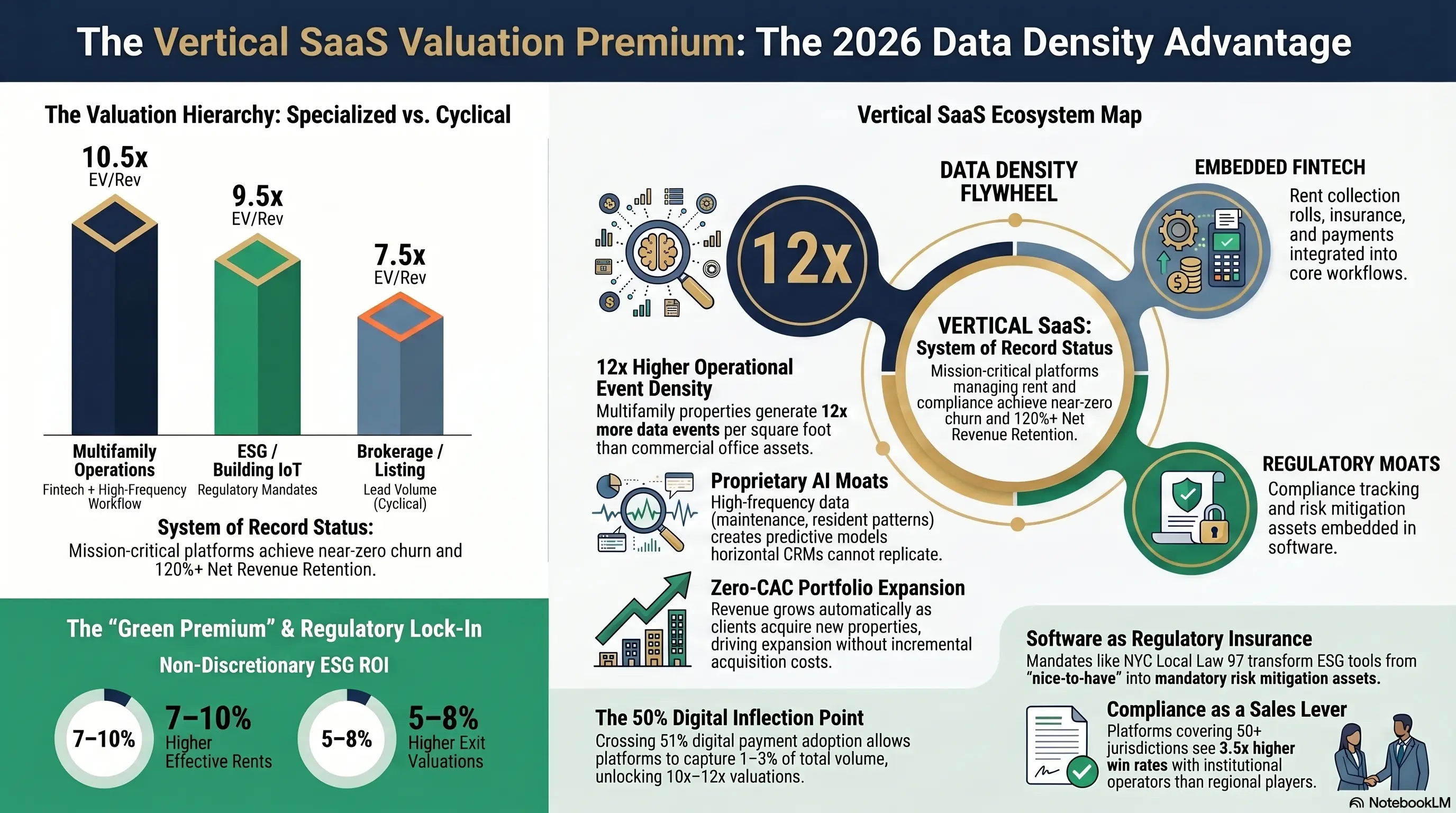
The most impenetrable competitive advantages in 2026 are "Regulatory Moats"---software that doesn't just manage data, but assumes the legal risk and compliance complexity of the industry. This is best personified by the battle between Veeva Vault CRM and **Salesforce Life Sciences Cloud ** .While Salesforce is an enterprise giant, it struggles against Veeva because it treats Life Sciences as a configuration layer on a horizontal core. In 2026, compliance isn't a "feature" you toggle on; it's the core workflow. Veeva wins by baking in rigorous regulatory requirements that Salesforce users must still address via manual band-aids and third-party plugins.We see this same shift in fintech. A generic payment processor leaves the "nightmare of cross-border tax compliance" entirely on the merchant. Platforms like Paddle have built a moat by acting as a "Merchant of Record," assuming total liability for global sales tax and VAT. Similarly, Chargebee has specialized in the "spreadsheet gymnastics" of ASC 606 revenue recognition. In 2026, if your software isn't shielding you from regulatory risk, it is a liability.
4. Takeaway 3: The Intelligence Layer vs. The Data Layer
The winners of 2026 are moving beyond the "Data Layer"---which merely tells you what happened---and providing an "Intelligence Layer" that tells you what to do next . Traditional tools track spend; Vertical 2.0 tools like Ramp and Brex provide vendor intelligence to identify duplicate subscriptions and suggest better rates before the next billing cycle.This Intelligence Layer is defined by three non-negotiable features for 2026 SaaS:
Predictive Churn Alerts: ChurnZero's "ChurnScore" goes beyond usage logs to aggregate sentiment from emails and chats, flagging at-risk accounts before they exit.
AI Bank Feed Categorization: Leaders like QuickBooks now hit 95% accuracy in routine categorization, effectively turning the "Data Layer" of bookkeeping into an automated utility.
Automated Root Cause Analysis: Observability platforms like Dynatrace use "Davis" AI to pinpoint the origin of system failures in complex microservices, moving from "we have an outage" to "here is the fix."
5. Takeaway 4: Domain-Specific AI as the Ultimate Switching Barrier
AI is no longer an add-on; it is the core of the "AI-Enabled SaaS Stack." However, generic AI is easily replicated. The true moat in 2026 is domain-specific AI trained on industry-exclusive data points. **Skima AI ** has revolutionized recruitment not just with "AI," but with "Explainable Match Scores" that understand candidate sentiment and workflow nuances. John Deere's precision farming tools create a similar barrier by training models on proprietary soil and crop data. The strategic insight here is the "Switching Barrier": once an AI is trained on your organization's specific recruitment or yield nuances, leaving that platform means losing the intelligence , not just the data."Traditional manual monitoring is no longer sufficient. The rise of AIOps is taking this further: by 2026, an estimated 73% of enterprises are implementing AIOps to cope with alert fatigue and complex systems."
6. Takeaway 5: The "Software + Partner" Hybrid Model
In a Vertical 2.0 world, the most successful SaaS deployments are intentionally "un-DIY-able." The complexity of modern tax law, multi-entity accounting, and AI-driven workflows means that software alone is no longer the solution.The "Software + Partner" hybrid model, exemplified by the relationship between platforms and certified partners like Bookkeeper360 , is now a structural component of the product's success. In 2026, the partner is not an optional service; they are the architect who ensures the "Intelligence Layer" is actually fed accurate data. If the setup is rushed or DIY-ed, the AI produces "hallucinated" insights. The difference between usable data and a nightmare comes down to the expertise baked into the implementation.
7. Conclusion: The Question for the Next Board Meeting
The era of the "Modular Monolith" is over. The technical backbone of 2026 is a transition toward microservices and AI-enabled vertical solutions supported by AIOps to manage the resulting complexity.As you sit in your next board meeting, the question is no longer about which tool has more features. The question is: "In a world where horizontal markets are overcrowded and generic, are we building a general tool for everyone, or a specialized moat for the few?" In 2026, workflow superiority is the only path to a winning margin.
If this saved you time or helped you make a better buying decision, you can support the work.
Support the WorkNo PayPal account needed.