
On this page
The Observability Tax Is Optional
SaaS Lasso Editorial·
The "Observability Tax" is Optional: Why Engineering Leaders are Pivoting to OpenTelemetry in 2026
1. Introduction: The Complexity Trap
In 2026, the architectural shift toward microservices and cloud-native environments has passed the point of no return. While distributed systems provide the agility businesses crave, they have created a data explosion that traditional manual monitoring simply cannot handle. We have moved beyond the era of "Monitoring"---simply asking if a system is up---to the era of "Observability," which demands we understand why it is behaving a certain way.Modern observability is the "nervous system" of your IT landscape. It provides the awareness required to react to incidents in real-time, but for many engineering leaders, this nervous system has come with a crippling price tag. In 2026, the most successful leaders are realizing that the "Observability Tax"---that bloated line item for proprietary data ingestion and storage---is entirely optional.
2. OpenTelemetry: The End of Vendor Lock-in
The greatest threat to an observability budget is vendor lock-in. Historically, switching from a commercial giant like Datadog, New Relic, or Dynatrace meant a complete, soul-crushing re-instrumentation of your entire code base. In 2026, OpenTelemetry (OTel) has shattered this paradigm.OTel is the industry standard for instrumentation, providing a vendor-neutral framework for collecting metrics, logs, and traces. By instrumenting with OTel APIs, your teams gain the ultimate strategic lever: the ability to move telemetry data between commercial backends and open-source stacks (like Prometheus or Jaeger) with minimal code changes. This flexibility isn't just a technical convenience; it's a financial safeguard that ensures your providers remain competitive on price and performance."Investing time in learning OpenTelemetry in 2026 is absolutely worth it, as it future-proofs your observability skills."For the modern CTO, OTel represents the transition from being a "renter" of proprietary agents to an "owner" of their own telemetry data.
3. The Cost Revolution: Why "Index Everything" is a Legacy Mindset
Relying on the ELK stack (Elasticsearch, Logstash, Kibana) in 2026 is effectively writing a blank check to your infrastructure provider. The legacy mindset of "index everything" via full-text search is a budget liability that cannot scale with modern data volumes.The shift is toward metadata-labeling approaches, championed by tools like Grafana Loki. By indexing only the labels rather than every string of text, Loki is significantly cheaper and simpler to run. Furthermore, modern backends now allow leaders to query high-cardinality data ---patterns that traditional systems simply cannot index without crashing or doubling your bill.
2026 Observability Tax Audit:
The Legacy Tax: Commercial "per-host" pricing models and full-text indexing create an unpredictable budget that punishes you for scaling your infrastructure.
The Modern Pivot: Metadata-driven approaches (Loki) and high-cardinality analytics (Honeycomb) decouple your costs from your data volume, allowing for 10x growth without a 10x increase in spend.
4. AIOps: Curing the "Needle in a Haystack" Problem
With microservices generating billions of telemetry events, human-led monitoring has become a bottleneck. This is why **73% of enterprises have implemented AIOps by 2026 ** . The goal is to eliminate "alert fatigue"---the deafening noise of thousands of non-critical pings---by utilizing a "digital ops assistant."AIOps platforms provide automated root cause analysis, instantly pinpointing failures in a complex chain of interactions. More importantly, we are seeing the rise of self-healing actions . By 2026, mature teams don't just get an alert; their AI has already attempted to restart the failed container or roll back a buggy deployment before the engineer even opens their laptop."There is no future of IT operations that does not include AIOps."The role of the DevOps engineer has shifted: they no longer monitor dashboards; they tune the AI that monitors the system.
5. The Convergence of the "Three Pillars"
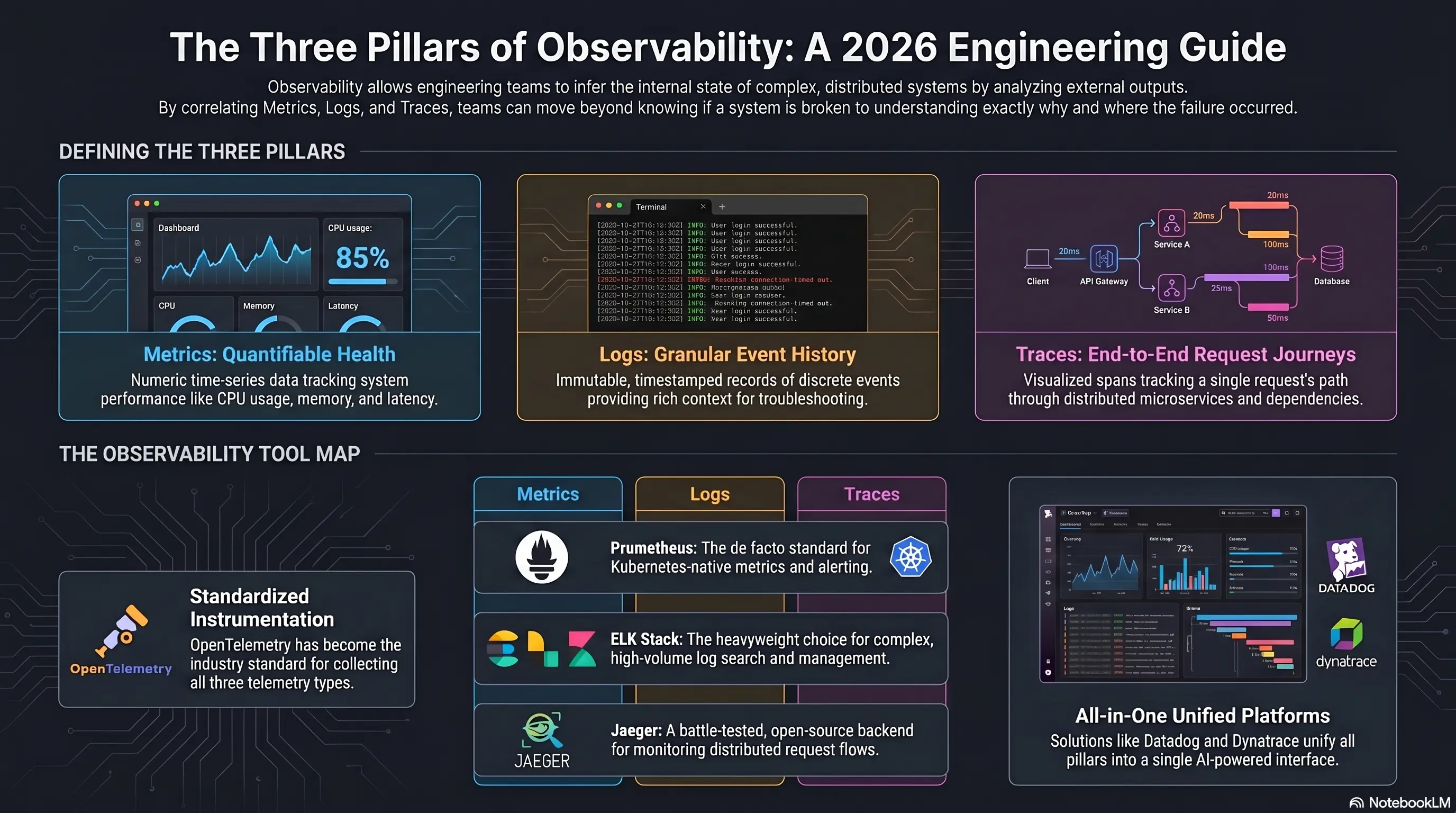
In 2026, the "Three Pillars of Observability" (metrics, logs, and traces) are no longer siloed tools. We have entered the era of **Unified Observability ** , where Prometheus, Loki, and Jaeger are stitched into a single source of truth.This convergence is driven by the need to protect Service Level Objectives (SLOs) and, by extension, user trust and revenue. A unified stack enables a high-velocity troubleshooting workflow:
A high-level metric alert flags a dip in an SLO.
The engineer clicks directly from the alert into a specific **trace span ** to identify the stalling service.
The engineer views the correlated logs for that exact trace to see the specific error.
By removing the "context-switching tax" between different tools, teams reduce downtime and protect the bottom line.
6. Security is No Longer a Separate Silo (DevSecOps)
The distinction between operations and security data is a relic of the past. In 2026, "DevSecOps" maturity is defined by **Continuous Monitoring ** of configurations, access patterns, and vulnerabilities.Modern observability platforms are now the primary line of defense against security anomalies. A spike in error rates or an unusual login pattern is no longer just an "ops issue"---it is a security signal. By using the same logging and observability framework for both operations and security, organizations eliminate tool sprawl, facilitate audit trails, and ensure that security is a proactive component of system health rather than an expensive afterthought.
7. Conclusion: The Forward-Looking Summary
The systems of the early 2020s are no longer sustainable. The future of observability in 2026 belongs to those who embrace open standards like OTel, cost-efficient metadata indexing, and AI-driven automation. This shift isn't just about technical elegance; it is about achieving Reliability + Cost-Efficiency in an increasingly complex world.As an engineering leader, you must ask yourself: is your current observability spend actually buying you answers, or are you simply paying a "tax" for data you can't effectively query? In 2026, the tax is optional. The answers are not.
If this saved you time or helped you make a better buying decision, you can support the work.
Support the WorkNo PayPal account needed.