
On this page
Vertical SaaS Data Density
SaaS Lasso Editorial·
The Data Density Premium: Why Vertical SaaS is Decimating Horizontal Platforms in 2026
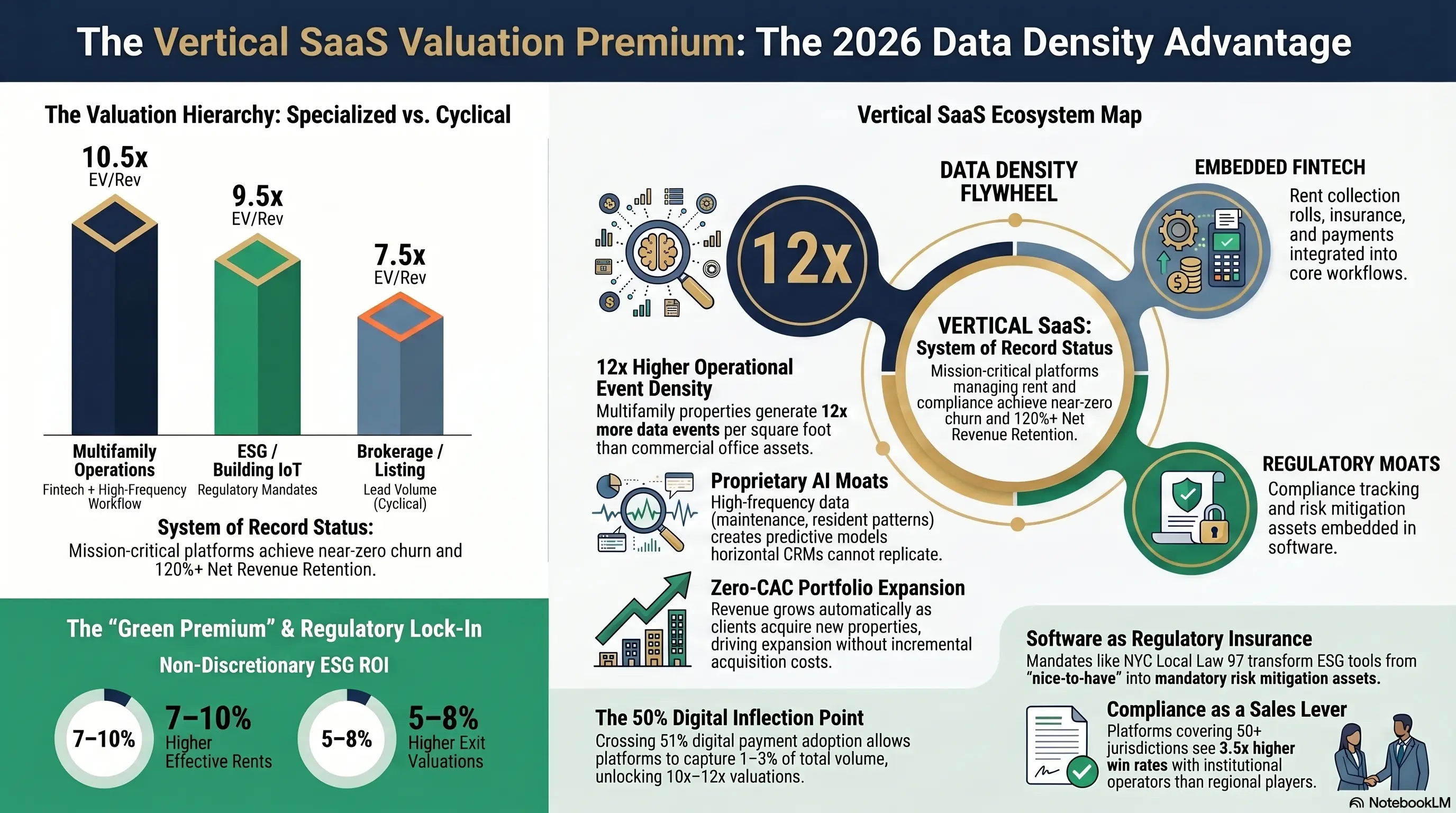
The Great Software Separation
The software market in 2026 has fractured into two distinct realities. We are witnessing "The Great Software Separation," a flight to quality where generic, horizontal platforms struggle with compressed multiples while industry-specific tools command record premiums. The delta between these valuations is widening because the market has finally realized that "one-size-fits-all" is a growth ceiling.The macro trajectory is undeniable. The global vertical SaaS market, valued at $106.5 billion in 2024, is on a relentless climb toward a projected $369 billion by 2033. This 16.3% CAGR represents a fundamental shift in buyer behavior. For the modern enterprise, software that "deeply understands" the nuances of a specific industry is no longer a luxury---it is the only viable path to superior unit economics and sustainable growth.
Solving the "Analog Ghost" Problem
Horizontal giants like Salesforce and Microsoft have historically reached a saturation point because they cannot solve the "analog ghost"---the stubborn reliance on clipboards, fragmented spreadsheets, and manual checks in industries like healthcare, agriculture, and construction. While generic platforms offer wide, shallow functionality, they fail to capture the proprietary nature of high-stakes workflows.Vertical SaaS gains a permanent foothold by digitizing the nuance that generic fields ignore. Whether it is a maritime logistics platform managing port-specific regulatory checks or an eldercare management tool coordinating complex staffing and compliance, these specialized workflows create moats that horizontal players simply cannot bridge. As noted in the 2026 Vertical SaaS Trends report, the most aggressive growth is currently concentrated in these "analog-heavy" sectors that are finally abandoning manual processes for industry-specific cloud tools.
Revenue Multiplication and the Outcome-Based Shift
In 2026, the strategic play is no longer just selling software; it is turning a software cost center into a profit-sharing ecosystem. Leading vertical platforms are multiplying revenue per customer by embedding services that were previously managed through external vendors.Research indicates that 88% of companies implementing embedded finance reported increased engagement, while 85% saw improved acquisition. By integrating these services, platforms move from being a line item to a mission-critical financial partner. Standard embedded services in 2026 now include:
- Recruiting and Onboarding: Automated talent suites built for specific regulatory environments.
- Insurance and Risk Monitoring: Real-time coverage tied to operational data.
- Payroll and Payments: Direct money movement within the core workflow.
- Retention and Compliance Analytics: Real-time monitoring of industry-specific labor laws.
Crucially, this shift is accompanied by a transition from traditional "seat-based" pricing to "outcome-based" or "unit-based" models. By pricing per hire, per claim, or per shipment, vertical SaaS providers align their revenue directly with the value they create for the customer, capturing a larger share of the industry's economic output.
The Valuation Driver: Prescriptive Analytics
The reason vertical platforms command a premium is "high-frequency data density." Horizontal platforms possess vast but disconnected data lakes. Vertical platforms, however, own the entire data pipeline for their sector. This allows them to move beyond "rear-view reporting"---simply telling a customer what happened---to the 2026 gold standard: predictive and prescriptive guidance.Leading platforms now tie their dashboards to specific industry KPIs like "utilization rates" or "compliance audit trails." Rather than a passive record-keeper, the software acts as a proactive partner, suggesting specific interventions for compensation or retention. Owning the data pipeline for a vertical is infinitely more valuable than a wide, shallow pool of horizontal data because it enables the software to dictate the "best next action" for the business.
Retention as the Ultimate Health Indicator
In the current investment climate, sustainable growth is valued far higher than hypergrowth paired with poor unit economics. Consequently, Net Revenue Retention (NRR) has surpassed MRR as the primary indicator of a company's health. Vertical SaaS achieves superior NRR because the switching costs are nearly insurmountable once a platform owns mission-critical vertical workflows.According to the Averi Benchmarks Report , the 2026 metrics for the sector are:
Median NRR (All SaaS): 101%
Vertical SaaS Target: 106%
Best-in-Class: 120--130%Companies maintaining an NRR above 100% grow 1.5--3x faster than their peers. In vertical markets, this expansion revenue is driven by a customer base that finds it easier to buy more from an existing partner than to integrate a new, generic vendor.
The AI Divide: Native Agentic Architecture
The market has split into a hierarchy of intelligence. There is a widening gap between "AI-enabled" tools---which merely append a chat box to 2010-era features---and "Native AI" or "Agentic" architectures.Native AI platforms do not just assist the user; they are the work. Built on real-time data pipelines and microservices, these platforms automate end-to-end processes such as candidate sourcing, screening, and scheduling without human intervention. The 2026 Vertical SaaS Trends analysis highlights this as a critical inflection point, where leaders are restructuring their entire products around autonomous agents that price for outcomes, not just efficiency.
The Hunter Mentality: Strategic M&A
Vertical SaaS vendors have evolved from being the "hunted" to being the "hunters." In previous cycles, horizontal giants acquired niche players to expand their feature sets. Today, vertical leaders are the primary acquirers, using M&A to deepen their dominance within a single industry rather than venturing into new ones.We see this in the HR tech space, where an Applicant Tracking System (ATS) might acquire a compliance training tool or a workforce planning platform to offer a seamless talent suite. This "hunter" mentality reinforces the platform's position as the industry's indispensable operating system, simultaneously increasing switching costs and solidifying valuation.
The Future of Domain Expertise
The "Data Density Advantage" is the primary engine behind the 16.3% CAGR projected through 2033. As generic software is commoditized, the value of deep domain expertise---hard-coded into the architecture of a platform---continues to skyrocket. The winners in this $369 billion market are those who understand that in 2026, software is no longer a tool for work; it is the infrastructure of the work itself.In an era defined by agentic AI and specialized data, every founder and investor must answer one fundamental question: Is your platform a generic utility, or is it the indispensable operating system of your industry?
If this saved you time or helped you make a better buying decision, you can support the work.
Support the WorkNo PayPal account needed.